The 1-billionth surveillance camera went up in 2021. Do the math, and that's roughly one lens for every eight people alive. Troy Hale wants you to sit with that number for four minutes, and then decide whether the word "free" still means what you think it means.
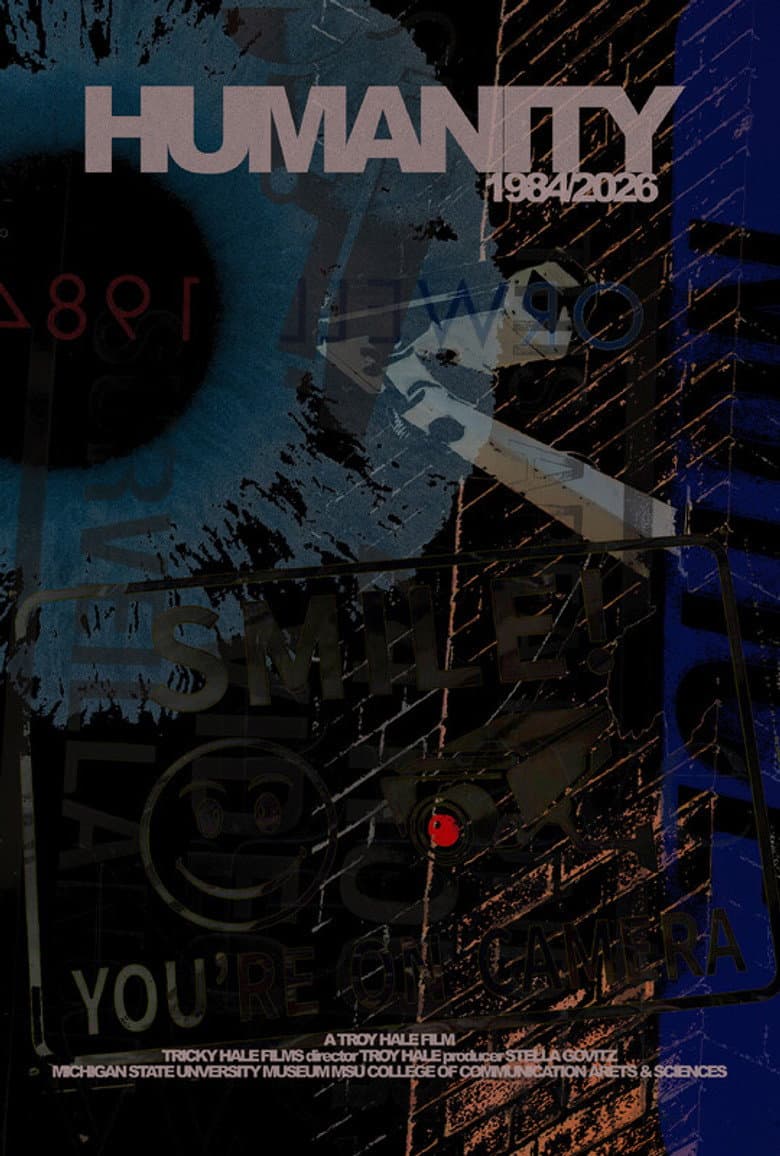
Hale's new short, Humanity (1984/2026), lands on OTT Stories today, and it isn't interested in the slow-burn dystopia of a feature. It's a quick, surgical jab at the world we already live in, arriving right as arguments over automated license-plate readers like FLOCK cameras are spilling out of city council meetings and into everyday conversation. The title alone does the heavy lifting: Orwell's warning, updated with a second date that happens to be now.
Release Date & Where to Watch
The film arrives September 12, 2026, which is to say today, and it's streaming exclusively on OTT Stories. At four minutes, it's the kind of thing you can watch between a coffee refill and a phone call, though the unease it leaves behind may linger considerably longer. There's no theatrical window, no festival rollout announced, no staggered regional schedule. Just a short, sharp drop onto one platform, which feels appropriate for a film about cameras that never blink. If you're the type who likes to know exactly how long a commitment is before pressing play, this one respects your time in the most literal way possible.
Cast & Crew
Hale directs, and the cast list hasn't been made public. That anonymity may be the point. A documentary-style piece about mass observation doesn't necessarily need a marquee name; it needs faces that could plausibly be yours, pulled from a crowd, tagged, and filed. Given the film's subject matter, keeping the performers unnamed reads less like a marketing gap and more like a deliberate choice about who surveillance actually watches. We're all the cast here. The film carries an English-language, Hollywood production pedigree, and it runs four minutes. TMDb currently lists it at 0/10, but that's simply a reflection of how few people have rated it yet rather than a verdict on its quality. New releases often sit at zero until audiences start logging their scores.
Story & What to Expect
The premise is stated plainly enough to be genuinely unsettling: in a surveillance state, you are always being watched. The 1-billionth camera milestone passed in 2021, putting us at approximately one camera for every eight human beings on the planet. Stack facial recognition and AI on top of that hardware, and the film's central claim is that human movement becomes predictable, not just observable. The reference point is 1984, but the arithmetic is 2026. This isn't speculative science fiction dressed up in silver jumpsuits. It's an argument about infrastructure already in place, and the title's dual dates suggest a thesis: Orwell imagined the mechanism, and we built it, quietly, one pole-mounted unit at a time.
Expect four minutes of tightly compressed anxiety. Short documentaries at this runtime tend to work through accumulation rather than narrative arc. A statistic lands. A comparison lands. A question lands. Whether Hale leans on archival footage, talking heads, or something more experimental isn't clear from the available materials, but the metadata's framing of "current outrage surrounding FLOCK cameras" tells you the film is anchored to a live debate rather than a hypothetical future. The closing question, "Are we really free?," is doing open heart surgery with a rhetorical scalpel. It doesn't answer itself. That's the design.
Why It's Worth Watching
Because the numbers in this film aren't hypothetical, and that's what separates it from a dozen other dystopian shorts. One camera per eight humans is a real ratio. Facial recognition is in real airports, real stadiums, real retail stores. The FLOCK controversy is unfolding in real municipalities right now, with residents showing up to meetings to ask who is watching the watchers. Hale's film steps into that moment rather than predicting a distant one.
Four minutes is also the ideal length for this argument. A feature would risk exhausting its audience with dread; a short forces the viewer to absorb the premise before the instinct to look away kicks in. The 0/10 TMDb rating and unlisted cast shouldn't deter anyone. Those are the marks of a title too new to have been measured, not one measured and found wanting.
There's a particular irony in watching a film about surveillance on a streaming platform that is, itself, tracking what you watch, when you pause, and where you abandon ship. Maybe that's part of the experience. Maybe Hale counted on it. Either way, Humanity (1984/2026) asks a question most of us have learned to answer reflexively rather than honestly. Four minutes is a small price to pay for sitting with it properly.
Stream it on OTT Stories now. Just maybe check what's watching you back.